Tooth Decay Jaw Bone . When teeth are lost or decayed, the jawbone no longer receives stimulation for teeth and the bone begins to decay as a result. Bone loss can occur in the upper (maxilla) and lower (mandibular) jawbone for a number of reasons. Dental jaw model with teeth, roots, gums, gum disease from www.rmperiohealth.com When teeth are lost or decayed, the jawbone no longer receives stimulation for teeth and the bone begins to decay as a result. A red and swollen area appears on the skin. In this case, the bacteria will start to build up in the teeth and gums and cause tooth decay.
Decay Keras. By jacob richeimer on february 6, 2019 under keras 5 minute read weight decay, or l2 regularization, is a common regularization method used in training neural networks. But there is an option to explicitly mention the decay in the adam parameter options in keras.
python Decay parameter of Adam optimizer in Keras from stackoverflow.com
So, let’s discuss its keras api. The learning rate schedule is also serializable and deserializable using tf.keras.optimizers.schedules.serialize and tf.keras. With a team of extremely dedicated and quality lecturers, keras adam learning rate decay will not only be a place to share knowledge but also to help students get inspired to explore and discover many creative ideas from.
My Problem Is To Choose The Decay Step In Such A Way That The Decay Occurs Every Two Epochs.
We’ll then dive into why we may want to adjust our learning rate during training. A learningrateschedule that uses an inverse time decay schedule. The learning rate schedule is also serializable and deserializable using tf.keras.optimizers.schedules.serialize and tf.keras.optimizers.schedules.deserialize.
A Learningrateschedule That Uses A Polynomial Decay Schedule.
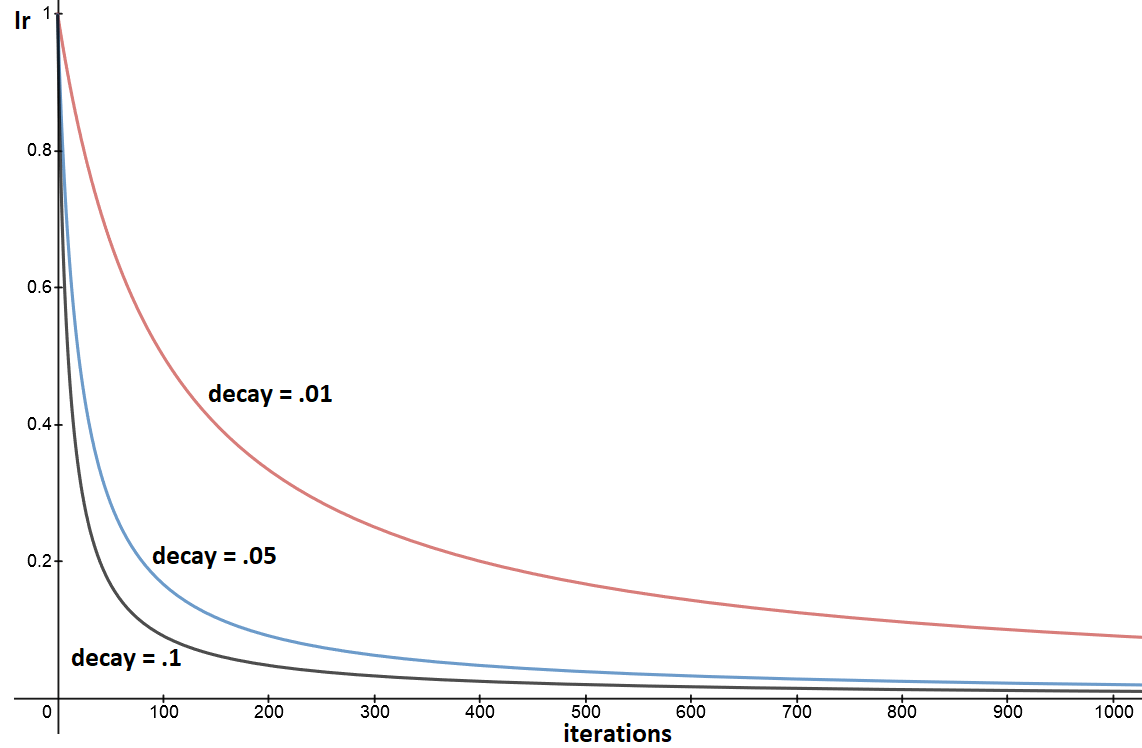
It is commonly observed that a monotonically decreasing learning rate, whose degree of change is carefully chosen, results in a better performing model. Looking into the source code of keras, the sgd optimizer takes decay and lr arguments and update the learning rate by a decreasing factor in each epoch. You can pass this schedule directly into a tf.keras.optimizers.optimizer as the learning rate.
If The Argument Staircase Is True, Then Step / Decay_Steps Is An Integer Division And The Decayed Learning Rate Follows A Staircase Function.
When fitting a keras model, decay every 100000 steps with a base. If it is a big value the weights of the model will begin to oscillate and they will have big changes, preventing the model. The documentation that you're referring to includes a reference to the python source (just click on the [source] link in the appropriate place), that can be used to answer your questions.
The Key Difference Is The Pesky Factor Of 2!
By jacob richeimer on february 6, 2019 under keras 5 minute read weight decay, or l2 regularization, is a common regularization method used in training neural networks. Decay parameter in keras optimizers. Francois chollet from google (and author of keras) in his 2016 paper titled “xception:
The Stochastic Gradient Descent Optimization Algorithm Implementation In The Sgd Class Has An Argument Called Decay.
Viewed 12k times 7 $\begingroup$ i'm currently training a cnn with keras and i'm using the adam optimizer. In the first part of this guide, we’ll discuss why the learning rate is the most important hyperparameter when it comes to training your own deep neural networks. The learning rate schedule is also serializable and deserializable using tf.keras.optimizers.schedules.serialize and tf.keras.


Comments
Post a Comment